Onaqui Wild Horses


(near Simpson Springs, West Desert) When you first see them, it’s tough to describe what you’re looking at. Not because it’s unbelievable, but because there’s something about seeing wild horses roaming free across a vast stretch of Utah’s West Desert that stirs something in you.

These are the wild horses of the Onaqui Mountain Herd Management Area near Simpson Springs. Their territory out here is huge. There are more than 240,000 wide open acres of desert and mountains for these horses to roam. Because of all that open space, you might think it would make finding them easy.
It certainly isn't, but that's part of the fun.

Sometimes the horses are close to the old Pony Express dirt road. Other times, you can drive for miles staring across the desert and wondering where they are. A dark spot in the distance looks like a horse, but as you get closer, it turns into a bush. Or maybe even a cow.
That's where Kylie comes in.
Every time we go looking for the wild horses, somehow she finds them. She was born and raised in Utah and has spent time near horses, so maybe she has some "horse whisperer" thing going on.

Once you do find them, you’re looking at a herd with roots going back more than a century. According to the Bureau of Land Management, early settlers and the cavalry brought horses into this part of Utah in the late 1800's. Brown is still the dominant color, but through the years, other horses have been introduced into the herd to help maintain genetic diversity. Today, you can see sorrels, roans, buckskins, blacks, palominos, grays, and pintos.

Sometimes you have to follow a small dirt road to get close to where the herd is hanging out. The horses seem like they're used to vehicles, although a few of them will stop what they’re doing and stare at you. I always imagine those are the protectors of the herd.

One time, we got really lucky finding them. There’s a water trough just off the Pony Express road and when we arrived, the horses were gathered around it drinking. We parked, shut off the car, and just watched.
Suddenly, our windshield became a giant movie screen showing images of the American West. That’s the feeling I was talking about earlier.

As Americans, we grow up hearing stories about the Wild West... of cowboys, explorers, and pioneers making their way across an enormous, untamed landscape. We’ve seen the Hollywood version, too, with John Wayne riding across the screen doing his thing. In all those stories, there were always horses.
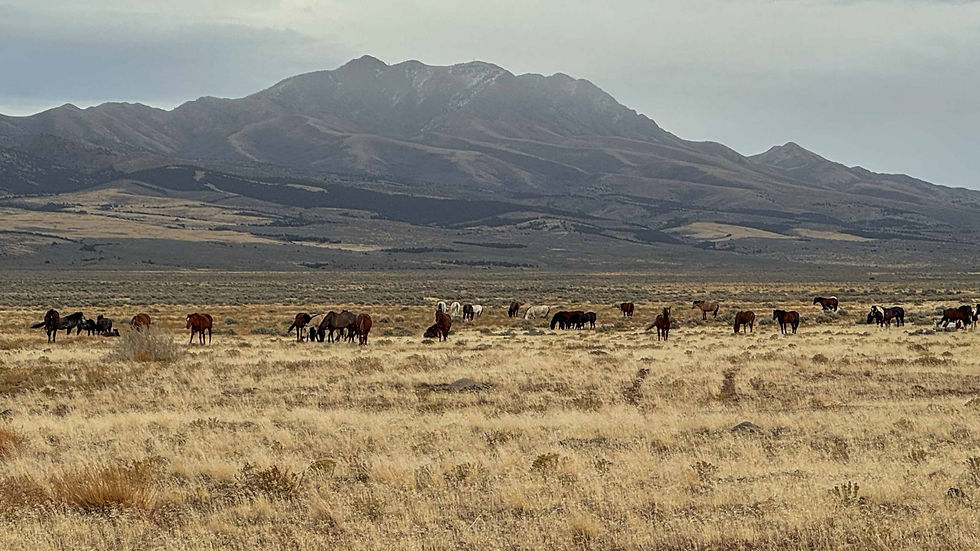
Sitting in our Jeep quietly in the Utah desert and watching this herd drink and slowly walk by brings some of those images back. For a few minutes, it feels like you’re getting a tiny glimpse of something that has mostly disappeared.

Of course, we brought our dog Aspen. She loves seeing the horses, sniffing the air, and occasionally trying to speak to them. I’m pretty sure she wonders how dogs got so big out here.

We’ve also brought Aspen’s friends Molly and Dolly on a couple of trips when we’ve been puppysitting them. Dolly, a pit bull mix, likes to grumble at the horses, which we quickly have to shush her because we would rather not spook several thousand pounds of wildlife.
Molly, a borador like Aspen, couldn’t care less about the horses. She spends most of her time searching the car for a ball.

There is, of course, a serious and controversial side to the overall story of these horses. There are several herds in Utah and across the West, and how they should be managed has been debated for years. Sometimes, the BLM does roundups and gathers the horses when officials believe populations have grown beyond what the land can sustainably support with sagebrush and vegetation, along with natural and human-made water sources. The BLM wants to keep the Onaqui Mountain herd to between 120 to 210 horses

On the other side, advocates for the wild horses sometimes disagree with those decisions and argue that the herds should be allowed to remain free with as little human intervention as possible.
Even this far out in the desert, you can’t completely escape politics.
While we watched them, though, the horses don’t seem particularly interested in the debate. They’re just being horses.

We’ve been fortunate during our visits. A few times, we were the only humans around. Other times, it felt like an outdoor zoo with photographers and visitors lining the roads.
I don’t blame anyone for wanting to see them.

But if you go, remember that these horses really are wild. The BLM asks visitors to stay at least 100 feet away and to never feed or pet them. They’re big, fast and unpredictable. When they run, that might be my favorite part. Seeing an animal as majestic and graceful as a wild horse galloping at full speed and completely free is something else.

You don’t have to spend much time here. Or you can spend an entire day. We once packed a picnic and ate at the gazebo at the Simpson Springs campground after watching the horses for a while. One time, we were out here when a thunderstorm rolled through. The sounds of thunder rumbled across the desert and with an echo off the mountains is an experience we've only had once, but we'd love to hear it again.

If you find the horses, and get close enough to watch them, I hope you get the same feeling I had... that it's truly a chance to see something that still feels wonderfully out of place in the modern world.
It’s a glimpse of what the American West used to look like. And fortunately, you get to experience it from your car instead of a covered wagon.

LOCATION Some of the general locations where we have found them in the past: Open Desert Water Trough Open Desert Near Pony Express Road Pond of Water Simpson Springs Pony Express Station INFORMATION




Comments